Saudis may release names of 'players' behind 9/11 attacks in 2001Since the terror attacks on September 11th, 2001,
9/11 Truthers have been constantly searching for the real culprits
behind the tragic events of that day. 15 of the terrorists believed to
have carried out the attacks were Saudi nationals, yet Saudi Arabia has
never been held accountable for what happened, with Barack Obama even
going as far as to veto any claims made by the victims against Saudi
Arabia.
Now, according to former CIA contractor, Steven Kelly, it looks as
though the Saudis are going to come forward with names of the "major
players" behind the attacks, claiming that Saudi Arabia was only "a
minor player in the charade", even going as far as to warn the
Rothschild and Bush families that the revelations will destroy them.
SCROLL DOWN FOR VIDEO PressTV reports: The United States is really afraid that the Saudis would
reveal the names of other players behind the scene of carrying out the
September 11, 2001 attacks, a former CIA contractor has told Press TV.
“Saudi Arabia would certainly use their resources to show that they
were actually, if anything, just a minor player in the charade," Steven
Kelley said on Saturday.
"Israel, the Zionist Mossad, the CIA, the NSA, the [former US
president George W.] Bush family etc. are the major players,” he added.
Kelly also said if the truth comes out about what the United States
and other parties did concerning the 9/11 attacks, “ultimately this will
undo the entire US government and the entire new world order.”
The revelation “will hurt US interests abroad, because if the new
world order is destroyed and the Rothschild’s and all of these culprits
are finally brought to justice, then will be rebuilding from scratch,”
he noted.
On September 23, US President Barack Obama used his veto power to
block legislation that allows the victims of the September 11, 2001
attacks to sue Saudi Arabia for reparations.
The attacks were conducted by 19 terrorists including 15 Saudi
nationals who killed 2,996 people and injured over 6,000 others, after
crashing two planes into the Twin Towers in New York and also hitting a
plane into the Pentagon building in Arlington County, Virginia, causing
$3 trillion in total costs.
Kelly further questioned the official narrative about the 9/11
attacks, saying, “There’s really more evidence to support that this was a
controlled demolition.”
US Congress on Wednesday voted to override President Obama’s veto of a
legislation that allows victims of the September 11, 2001 attacks to
sue Saudi Arabia for any role in the plot.
Since the terror attacks on September 11th, 2001, 9/11
Truthers have been constantly searching for the real culprits behind the
tragic events of that day. 15 of the terrorists believed to have
carried out the attacks were Saudi nationals, yet Saudi Arabia has never
been held accountable for what happened, with Barack Obama even going
as far as to veto any claims made by the victims against Saudi Arabia.
Now, according to former CIA contractor, Steven Kelly, it
looks as though the Saudis are going to come forward with names of the
“major players” behind the attacks, claiming that Saudi Arabia was only
“a minor player in the charade”, even going as far as to warn the
Rothschild and Bush families that the revelations will destroy them.
The United States is really afraid that the Saudis would
reveal the names of other players behind the scene of carrying out the
September 11, 2001 attacks, a former CIA contractor has told Press TV.
“Saudi Arabia would certainly use their resources to show
that they were actually, if anything, just a minor player in the
charade,” Steven Kelley said on Saturday.
“Israel, the Zionist Mossad, the CIA, the NSA, the [former US
president George W.] Bush family etc. are the major players,” he added.
Kelly also said if the truth comes out about what the United States
and other parties did concerning the 9/11 attacks, “ultimately this will
undo the entire US government and the entire new world order.”
The revelation “will hurt US interests abroad, because if the new
world order is destroyed and the Rothschild’s and all of these culprits
are finally brought to justice, then will be rebuilding from scratch,”
he noted.
On September 23, US President Barack Obama used his veto
power to block legislation that allows the victims of the September 11,
2001 attacks to sue Saudi Arabia for reparations.
The attacks were conducted by 19 terrorists including 15 Saudi
nationals who killed 2,996 people and injured over 6,000 others, after
crashing two planes into the Twin Towers in New York and also hitting a
plane into the Pentagon building in Arlington County, Virginia, causing
$3 trillion in total costs.
Kelly further questioned the official narrative about the 9/11
attacks, saying, “There’s really more evidence to support that this was a
controlled demolition.”
US Congress on Wednesday voted to override President Obama’s veto of a
legislation that allows victims of the September 11, 2001 attacks to
sue Saudi Arabia for any role in the plot.
The Pentagon paid a British P.R. firm over half a billion
dollars to fake ISIS videos as part of a top-secret propaganda campaign
in Iraq.Bell Pottinger, a London-based right-wing P.R. firm, were given over
$500 million dollars to fake videos that appeared to be the work of
al-Qaida and ISIS. Salon.com reports:
It also created news stories that looked as though they were produced
by Arab media outlets, and distributed them through Middle Eastern news
networks.
The company worked in Camp Victory, the U.S. military base in Baghdad, side-by-side with high-ranking U.S. military officers.
The propaganda videos were personally approved by Gen. David Petraeus
— then the commander of U.S.-led coalition forces in Iraq, who would go
on to become the director of the CIA. On some occasions, even the White
House signed off on the propaganda materials.
These findings are the result of a major investigation by The Bureau
of Investigative Journalism, a British watchdog organization that is
also known for its extensive reporting on the covert U.S. drone wars in
Pakistan, Yemen and Somalia.
The Bureau of Investigative Journalism jointly published its findings in The Sunday Times of London and The Daily Beast.
Reporters reviewed government and corporate reports and interviewed
half a dozen former officials and contractors involved in the Iraq
propaganda campaign.
The former chairman of Bell Pottinger, Timothy Bell, told reporters
that his company worked on a “covert” military operation “covered by
various secrecy documents.” The firm reported to the Pentagon, the CIA
and the National Security Council.
Bell is a P.R. virtuoso who carefully crafted the image of former
British Prime Minister Margaret Thatcher, a hard-line right-wing leader.
Bell helped propel the Conservative Party to win three elections.
(Thatcher later returned the favor by nominating Bell for a knighthood.)
Bell has also worked with several repressive regimes. He has lobbied on behalf of the draconian Saudi monarchy, and The Economist reported in 2008 that the authoritarian regime in Belarus had “hired a U.K. spin doctor, Lord Timothy Bell, to polish its image abroad.”
In 2011, the Bureau of Investigative Journalism exposed
how senior executives at Bell Pottinger suggested they could manipulate
Google results to “drown” out negative coverage of human rights
violations and child labor. They also revealed that the P.R. firm has a
team that “sorts,” or alters, negative Wikipedia entries on its clients.
According to the organization’s new investigation, Bell Pottinger
worked during the Iraq War as a contractor under the U.S.’s Information
Operations Task Force and Joint Psychological Operations Task Force.
The fake al-Qaida propaganda films the P.R. company helped to produce
were used to monitor people watching them. The videos were burned on
CDs, which U.S. Marines would drop in locations such as houses they were
raiding. The CDs included software with an embedded code which linked
to a Google Analytics account, allowing the U.S. to monitor IP addresses
that played the CDs.
In addition to the fake al-Qaida videos, Bell Pottinger made TV
segments that looked as though they were produced by Arabic-language
news networks. Teams would create news packages and then send the videos
to TV stations across the Middle East. The fact that the stories were
created with the support of the U.S. government was sometimes kept
hidden, the Bureau reported.
A former Information Operations Task Force employee said the U.S.
government used contractors partly because they were operating in a
legal “gray area.”
The Bureau of Investigative Journalism called the propaganda campaign
“a huge media operation.” It cost more than $100 million per year, on
average, and employed as many as 300 British and Iraqi staff.
From 2007 to 2011, the Pentagon paid Bell Pottinger $540 million, the
Bureau confirmed. The reporters were also told that the P.R. company
made an additional $120 million in 2006, putting the potential total at
at least $660 million.
Bell Pottinger entered Iraq in 2004 with the goal of “promotion of
democratic elections” and a $5.8 million contract. This soon grew
enormously.
The British P.R. company was not alone. “Iraq was a lucrative
opportunity for many communications firms,” Bureau of Investigative
Journalism reporters Crofton Black and Abigail Fielding-Smith wrote.
They found that at least 40 media companies were paid for services in
Iraq from 2006 to 2008. But Bell Pottinger received the largest
contracts.
A former video editor for the company called the work “shocking,
eye-opening, life-changing.” He also said, “Somewhere in my conscience I
wondered whether this was the right thing to do.”
In 2005, it was revealed
that the Lincoln Group, a Washington P.R. firm, had worked with the
Pentagon to plant news articles in Iraqi newspapers, in what U.S.
military officers called an essential part of an “information war.”
Many media outlets compare the contemporary situation in Europe
with the days before WWII. I would like to make an important correction
here. Now we are watching the West fostering another Nazi regime
represented by Kiev junta and it makes remember the second half of the
1930s when it did the very same thing cooperating with Germany turned
into a fascist state.
Of course, the Ukraine we know today cannot measure up to Hitler’s
Germany. But the first blow is half the battle. The running amok Fuhrer
started as an unknown corporal preaching xenophobia and revenge.
It’s an open secret that Adolf Hitler was supported by the United
States. The US penetration was significant, especially its cooperation
with the German war industry. By 1933 the United States controlled key
branches of Germany’s economy, as well as several large banks such as
Deutsche Bank, Dresdner Bank, etc.
Big business started to trust Hitler. Those were the days of affluence for the National Socialist German Workers’ Party
as funds from abroad began to pour in. Thanks to large donations from
Fritz Thyssen’s group including the United Steelworks (Vereinigte
Stahlwerke AG), I.G. Farbenindustrie AG (Interessen-Gemeinschaft
Farbenindustrie AG) and mining industry tycoon Emil Kirdorf the party
received 6,4 million votes to become the second largest in the Reichstag
(parliament). Hjalmar Schacht (22 January 1877 – 3 June 1970), a German
economist, banker, liberal politician, and co-founder in 1918 of the
German Democratic Party, became the key connecting link between German
industry and foreign donors.
British business and banking interests also started to channel donations to the Nazi party. On January 4, 1932 Montague Norman, the Governor of the Bank of England from 1920 to 1944, met Hitler and German Chancellor Franz von Papen
to conclude a secret accord on providing funds for the National
Socialist German Workers’ Party. The US was also represented at this
meeting. Both Dulles brothers were present. Western historians shy away
from mentioning the fact. John Foster Dulles and Allen Dulles
were politically connected Wall Street lawyers, servants of corporate
power, who led the United States into an unseen war that decisively
shaped today’s world.
It is worth noting, that during the 1950s, when the Cold War was at
its peak, the two immensely powerful Dulles brothers led the United
States into a series of foreign adventures whose effects are still
shaking the world. John Foster Dulles was Secretary of State while his
brother, Allen Dulles, was director of the Central Intelligence Agency
(CIA).
Federal elections were held in Germany on 5 March 1933. As a result
of lavish donations coming in from abroad, the ruling Nazi Party led by
Adolf Hitler, who was appointed Chancellor on January 30, 1933,
registered a large increase in votes emerging as the largest party by
far. Nevertheless they failed to obtain an absolute majority in their
own right and needed the votes of their coalition partner, the German National People’s Party (DNVP), for a Reichstag majority.
The new German government was treated extremely favorably by US and
UK ruling circles. Western democracies kept silent when Berlin refused
to pay reparations. Hjalmar Schacht, President of the Reichsbank and
Minister of Economics, went to the United States in May 1933 to meet
President Franklin Delano Roosevelt and leading Wall Street bankers.
Germany was granted a $1 billion credit. And in June, during a visit to
Norman in London, Schacht requested an addition $2 billion in loans as
well as a reduction and eventual cessation of payment on old loans.
Thus, the Nazis got something that the previous government could not.
In the summer of 1934, Britain signed the Anglo-German Transfer
Agreement, which became one of the foundations of British policy towards
the Third Reich, and by the end of the 1930′s, Germany developed into
Britain’s primary trading partner. Schroeder’s bank turned into Germany
and Great Britain’s main agent, and in 1936, its New York branch merged
with a Rockefeller holding to create the investment bank «Schroeder,
Rockefeller and Co.», which the New York Times described as
«economic-propagandist axis of Berlin-Rome».
The ‘Secret Memorandum’ was issued by Adolf Hitler in August 1936.
The memorandum went out only to a few senior Nazi leaders and its
contents – information about the Four-Year Plan – was formally announced
to the party’s faithful in September 1936 at the party rally in
Nuremberg. The Secret Memorandum stated that in four years Germany
was to develop capable combat-ready armed forces and its economy was to
be mobilized to meet the needs of war. As he admitted to himself,
Hitler viewed foreign credit as the financial basis for his four-year
plan, so this didn’t raise the slightest alarm.
In August 1934, American oil giant Standard Oil purchased 730,000
acres of land in Germany and built large oil refineries that supplied
the Nazis with oil. At the same time, the United States secretly
provided Germany with the most modern equipment for its airplane
factories, which were slated to produce Germany’s military aircraft.
In turn, Germany received a large number of patents from several
American companies including Pratt and Whitney, Douglas, and the Bendix
Corporation, and the “Junkers-87″ dive-bomber was built using purely
American technology. As the war broke out, the monopolies stuck to the
good old tried-and-true rule – nothing personal, only business. By
1941, when the Second World War was in full swing, American investment
in the German economy totaled $475 million: Standard Oil invested $120
million alone, General Motors — $35 million, ITT — $30 million, and Ford
— $17.5 million.
What motivated the interest of Western business in the growing might of Nazi Germany?
The goal was to direct Hitler to the East involving a German invasion of Russia. The conquest of Lebensraum
(«living space») was for Hitler and the rest of the National Socialists
the most important German foreign policy goal. At his first meeting
with the leading Generals and Admirals of the Reich («Empire») on
February 3, 1933, Hitler spoke of “conquest of Lebensraum” in the East
and ruthless ‘Germanization’ as his two ultimate foreign policy
objectives.
For Hitler, the land which would provide sufficient Lebensraum for
Germany was the Soviet Union, which in Hitler eyes was both a nation
that possessed vast and rich agricultural land and was inhabited by what
Hitler considered as Slavic Untermenschen (sub-humans)
ruled over by what he regarded as a gang of blood-thirsty, but grossly
incompetent “Jewish revolutionaries”. These people were not
“Germanizable” in his eyes; only the soil was.
The US and Britain, which were firmly opposed to the rise of
Communism in the Soviet Union, tacitly endorsed Hitler’s “conquest of
Lebensraum” in the East, as initially stated in Mein Kampf:
“We National Socialists consciously draw a line under the
direction of our foreign policy war. We begin where we ended six
centuries ago. We stop the perpetual Germanic march towards the south
and west of Europe, and have the view on the country in the east. We
finally put the colonial and commercial policy of the pre-war and go
over to the territorial policy of the future. But if we speak today in
Europe of new land, we primarily point to Russia and the border states”
In turn, the policy of appeasement was implemented by Western
countries in the 1930s against a background of financial and economic
cooperation of Anglo-American business interests with Nazi Germany.
In October 1930, Germany withdrew from both the Conference for the
Reduction and Limitation of Armaments of 1932–1934 (sometimes named the
World Disarmament Conference or Geneva Disarmament Conference) and the
League of Nations.
In March 1936, Hitler ordered his troops to openly re-enter the
Rhineland which had been demilitarized under the Versailles Treaty.
In March 1938 Austria was annexed.
The West did not react.
Fall Grün (Operation Green), a German military plan to occupy
Czechoslovakia, was approved by Hitler in December 1937. The execution
of Operation Green was called off after the Munich Pact was concluded
between England, France, Italy and Nazi Germany on September 30, 1938.
While Hitler signed the Munich agreement along with Arthur Neville
Chamberlain, Édouard Daladier and Benito Mussolini, the operation to
invade Czechoslovakia prevailed. On October 21 he ordered to start
preparations for the military annexation of the rest of Czechoslovakia
and the Klaipeda Region (also known as the Memel Territory) which had
been part of Lithuania since 1923.
In March 1939, Germany delivered an ultimatum to Poland demanding
renegotiation of the Danzig agreement. The Polish Corridor (also known
as Danzig Corridor, Corridor to the Sea or Gdansk Corridor) was a
territory located in the region of Pomerelia (eastern Pomerania,
formerly part of West Prussia), which provided the Second Republic of
Poland (1920–1939) with access to the Baltic Sea, thus dividing the bulk
of Germany from the province of East Prussia. The Free city of Danzig
(now the Polish city of Gdansk) was separate from both Poland and
Germany.
But Memel and Danzig were not the ultimate goal of Nazi Germany.
Adolph Hitler was fully aware that nobody in the West had any intention
to stand in his way. On April 1939 he secretly ordered Poland to be
attacked on September 1.
With the seizure of Czechoslovakia, Hitler’s duel-track policy was an
open secret even for the most shortsighted politicians and diplomats.
The Soviet Union still cherished hope to build a collective system of
security in Europe. It managed to make London and Paris start talks on
creating a really effective alliance to counter the aggressor. But these
talks were to reveal that the Western partners were reluctant to hinder
Hitler’s expansionary policy to the East. Sir Alexander Cadogan
(Permanent Under-Secretary at the Foreign Office) cited Chamberlain
saying he would rather resign the premiership than conclude an agreement
with the Soviets.
When Germany attacked Poland and the Second World War started,
Western leaders pointed their finger at both the Soviet Union and
Germany which signed the Non-Aggression Pact of August 23, 1939.
Supported by a choir of propaganda, they said it was not the Western
appeasement policy, but rather the USSR-Germany Non-Aggression Pact
which triggered the war.
In the wake of World War II, neither London, nor Washington, nor
Paris want to hear the truth about these historical events. They signed
the Nuremberg Trial verdict that found Germany guilty of grave crimes
and violations of international law and the laws of war, without
acknowledging who was behind Nazi Germany? The political and financial
elites of the United States, Great Britain and France were directly
involved in fostering Nazi regime. They incited Hitler to move east.
The West has never recognized its responsibility for supporting Hitler’s regime.
In today’s context, it has does its utmost to prevent Russia’s return on the world stage as a leading actor.
Today it is fostering the ulcer of Nazism and xenophobia emerging
right in front of our very eyes. To hide the truth it circulates the
Washington-invented and Europe-inculcated story about “Russian
aggression” against Ukraine.
Russia is demonized and provoked into direct confrontation with a
view to triggering its involvement in Ukraine’s internal conflict.
While the Kiev junta is not “in the same league” as Germany’s Nazi
regime, history shows that the ulcer of Nazism combined with the thrust
of Russophobia is gaining momentum. And sooner or later it may be beyond
the control of those who encouraged it in the first place.
The slogan “Ukraine above all” sounds very much like a remake of
Nazi Germany’s “Deutschland über alles”, (Germany above all). “Ukraine
above all” is being used to justify the crimes committed by Ukraine
forces in Novorossiya.
Edited by Global Research
Thursday 05 April 2007
New York - Now that the U.S. Congress is investigating the truth
of President George W. Bush's statements about the Iraq war, they might
look into one of his most startling assertions: that there was a link
between Saddam Hussein and Osama bin Laden.
Critics dismissed that as an invention. They were wrong. There
was a link, but not the one Bush was selling. The link between Hussein
and Bin Laden was their banker, BCCI. But the link went beyond the
dictator and the jihadist - it passed through Saudi Arabia and stretched
all the way to George W. Bush and his father.
BCCI was the Bank of Credit and Commerce International, a dirty
offshore bank that then-president Ronald Reagan's Central Intelligence
Agency used to run guns to Hussein, finance Osama bin Laden, move money
in the illegal Iran-Contra operation and carry out other "agency" black
ops. The Bushes also benefited privately; one of the bank's largest
Saudi investors helped bail out George W. Bush's troubled oil
investments.
BCCI was founded in 1972 by a Pakistani banker, Agha Hasan Abedi,
with the support of Sheik Zayed bin Sultan al Nahyan, ruler of Abu
Dhabi and head of the United Arab Emirates. Its corporate strategy was
money laundering. It became the banker for drug and arms traffickers,
corrupt officials, financial fraudsters, dictators and terrorists.
The CIA used BCCI Islamabad and other branches in Pakistan to
funnel some of the two billion dollars that Washington sent to Osama bin
Laden's Mujahadeen to help fight the Soviets in Afghanistan. It moved
the cash the Pakistani military and government officials skimmed from
U.S. aid to the Mujahadeen. It also moved money as required by the Saudi
intelligence services.
The BCCI operation gave Osama bin Laden an education in offshore
black finance that he would put to use when he organised the jihad
against the United States. He would move money through the Al-Taqwa
Bank, operating in offshore Nassau and Switzerland with two Osama
siblings as shareholders.
At the same time, BCCI helped Saddam Hussein, funneling millions
of dollars to the Atlanta branch of the Italian government-owned Banca
Nazionale del Lavoro (BNL), Baghdad's U.S. banker, so that from 1985 to
1989 it could make four billion dollars in secret loans to Iraq to help
it buy arms.
U.S. Congressman Henry Gonzalez held a hearing on BNL in 1992
during which he quoted from a confidential CIA document that said the
agency had long been aware that the bank's headquarters was involved in
the U.S. branch's Iraqi loans.
Kickbacks from 15 percent commissions on BNL-sponsored loans were
channeled into bank accounts held for Iraqi leaders via BCCI offices in
the Caymans as well as in offshore Luxembourg and Switzerland. BNL was a
client of Kissinger Associates, and Henry Kissinger was on the bank's
international advisory board, along with Brent Scowcroft, who would
become George Bush Sr.'s national security advisor. That connection
makes the Bush administration's surprise and indignation at "oil for
food" payoffs in Iraq seem disingenuous.
Important Saudis were influential in the bank. Sheik Kamal Adham,
brother-in-law of the late Saudi King Faisal, head of Saudi
intelligence from 1963 to 1979, and the CIA's liaison in the area,
became one of BCCI's largest shareholders. George Bush Sr. knew Adham
from his time running the CIA in 1975.
Another investor was Prince Turki bin Faisal al-Saud, who
succeeded Adham as Saudi intelligence chief. The family of Khalid Salem
bin Mahfouz, owner of the National Commercial Bank, the largest bank in
Saudi Arabia, banker to King Fahd and other members of the ruling
family, bought 20 to 30 percent of the stock for nearly one billion
dollars. Bin Mahfouz was put on the board of directors.
The Arabs' interest in the bank was more than financial. A
classified CIA memo on BCCI in the mid-1980s said that "its principal
shareholders are among the power elite of the Middle East, including the
rulers of Dubai and the United Arab Emirates, and several influential
Saudi Arabians. They are less interested in profitability than in
promoting the Muslim cause."
The Bushes' private links to the bank passed to Bin Mahfouz
through Texas businessman James R. Bath, who invested money in the
United States on behalf of the Saudi. In 1976, when Bush was the head of
the CIA, the agency sold some of the planes of Air America, a secret
"proprietary" airline it used during the Vietnam War, to Skyway, a
company owned by Bath and Bin Mahfouz. Bath then helped finance George
W. Bush's oil company, Arbusto Energy Inc., in 1979 and 1980.
When Harken Energy Corp., which had absorbed Arbusto (by then
merged with Spectrum 7 Energy), got into financial trouble in 1987,
Jackson Stephens of the powerful, politically-connected Arkansas
investment firm helped it secure 25 million dollars in financing from
the Union Bank of Switzerland. As part of that deal, a place on the
board was given to Harken shareholder Sheik Abdullah Taha Bakhsh, whose
chief banker was BCCI shareholder Bin Mahfouz.
Then, in 1988, George Bush Sr. was elected president. Harken
benefited by getting some new investors, including Salem bin Laden,
Osama bin Laden's half-brother, and Khalid bin Mahfouz. Osama bin Laden
himself was busy elsewhere at the time - organising al Qaeda.
The money BCCI stole before it was shut down in 1991 - somewhere
between 9.5 billion and 15 billion dollars - made its 20-year heist the
biggest bank fraud in history. Most of it was never recovered.
International banks' complicity in the offshore secrecy system
effectively covered up the money trail.
But in the years after the collapse of BCCI, Khalid bin Mahfouz
was still flush with cash. In 1992, he established the Muwafaq ("blessed
relief") Foundation in the offshore Channel Islands. The U.S. Treasury
Department called it "an al Qaeda front that receives funding from
wealthy Saudi businessmen."
When the BCCI scandal began to break in the late 1980s, the Sr.
Bush administration did what it could to sit on it. The Justice
Department went after the culprits - was virtually forced to - only
after New York District Attorney Robert Morgenthau did. But evidence
about BCCI's broader links exist in numerous U.S. and international
investigations. Now could be a good time to take another look at the
BCCI-Osama-Saddam-Saudi-Bush connection.
-------- Investigative journalist Lucy Komisar's chapter, "The BCCI Game: Banking on America, Banking on Jihad," appears in the new book A Game as Old as Empire, just published by Berrett-Koehler (San Francisco).
Many media outlets compare the contemporary situation in Europe
with the days before WWII. I would like to make an important correction
here. Now we are watching the West fostering another Nazi regime
represented by Kiev junta and it makes remember the second half of the
1930s when it did the very same thing cooperating with Germany turned
into a fascist state.
Of course, the Ukraine we know today cannot measure up to Hitler’s
Germany. But the first blow is half the battle. The running amok Fuhrer
started as an unknown corporal preaching xenophobia and revenge.
It’s an open secret that Adolf Hitler was supported by the United
States. The US penetration was significant, especially its cooperation
with the German war industry. By 1933 the United States controlled key
branches of Germany’s economy, as well as several large banks such as
Deutsche Bank, Dresdner Bank, etc.
Big business started to trust Hitler. Those were the days of affluence for the National Socialist German Workers’ Party
as funds from abroad began to pour in. Thanks to large donations from
Fritz Thyssen’s group including the United Steelworks (Vereinigte
Stahlwerke AG), I.G. Farbenindustrie AG (Interessen-Gemeinschaft
Farbenindustrie AG) and mining industry tycoon Emil Kirdorf the party
received 6,4 million votes to become the second largest in the Reichstag
(parliament). Hjalmar Schacht (22 January 1877 – 3 June 1970), a German
economist, banker, liberal politician, and co-founder in 1918 of the
German Democratic Party, became the key connecting link between German
industry and foreign donors.
British business and banking interests also started to channel donations to the Nazi party. On January 4, 1932 Montague Norman, the Governor of the Bank of England from 1920 to 1944, met Hitler and German Chancellor Franz von Papen
to conclude a secret accord on providing funds for the National
Socialist German Workers’ Party. The US was also represented at this
meeting. Both Dulles brothers were present. Western historians shy away
from mentioning the fact. John Foster Dulles and Allen Dulles
were politically connected Wall Street lawyers, servants of corporate
power, who led the United States into an unseen war that decisively
shaped today’s world.
It is worth noting, that during the 1950s, when the Cold War was at
its peak, the two immensely powerful Dulles brothers led the United
States into a series of foreign adventures whose effects are still
shaking the world. John Foster Dulles was Secretary of State while his
brother, Allen Dulles, was director of the Central Intelligence Agency
(CIA).
Federal elections were held in Germany on 5 March 1933. As a result
of lavish donations coming in from abroad, the ruling Nazi Party led by
Adolf Hitler, who was appointed Chancellor on January 30, 1933,
registered a large increase in votes emerging as the largest party by
far. Nevertheless they failed to obtain an absolute majority in their
own right and needed the votes of their coalition partner, the German National People’s Party (DNVP), for a Reichstag majority.
The new German government was treated extremely favorably by US and
UK ruling circles. Western democracies kept silent when Berlin refused
to pay reparations. Hjalmar Schacht, President of the Reichsbank and
Minister of Economics, went to the United States in May 1933 to meet
President Franklin Delano Roosevelt and leading Wall Street bankers.
Germany was granted a $1 billion credit. And in June, during a visit to
Norman in London, Schacht requested an addition $2 billion in loans as
well as a reduction and eventual cessation of payment on old loans.
Thus, the Nazis got something that the previous government could not.
In the summer of 1934, Britain signed the Anglo-German Transfer
Agreement, which became one of the foundations of British policy towards
the Third Reich, and by the end of the 1930′s, Germany developed into
Britain’s primary trading partner. Schroeder’s bank turned into Germany
and Great Britain’s main agent, and in 1936, its New York branch merged
with a Rockefeller holding to create the investment bank «Schroeder,
Rockefeller and Co.», which the New York Times described as
«economic-propagandist axis of Berlin-Rome».
The ‘Secret Memorandum’ was issued by Adolf Hitler in August 1936.
The memorandum went out only to a few senior Nazi leaders and its
contents – information about the Four-Year Plan – was formally announced
to the party’s faithful in September 1936 at the party rally in
Nuremberg. The Secret Memorandum stated that in four years Germany
was to develop capable combat-ready armed forces and its economy was to
be mobilized to meet the needs of war. As he admitted to himself,
Hitler viewed foreign credit as the financial basis for his four-year
plan, so this didn’t raise the slightest alarm.
In August 1934, American oil giant Standard Oil purchased 730,000
acres of land in Germany and built large oil refineries that supplied
the Nazis with oil. At the same time, the United States secretly
provided Germany with the most modern equipment for its airplane
factories, which were slated to produce Germany’s military aircraft.
In turn, Germany received a large number of patents from several
American companies including Pratt and Whitney, Douglas, and the Bendix
Corporation, and the “Junkers-87″ dive-bomber was built using purely
American technology. As the war broke out, the monopolies stuck to the
good old tried-and-true rule – nothing personal, only business. By
1941, when the Second World War was in full swing, American investment
in the German economy totaled $475 million: Standard Oil invested $120
million alone, General Motors — $35 million, ITT — $30 million, and Ford
— $17.5 million.
What motivated the interest of Western business in the growing might of Nazi Germany?
The goal was to direct Hitler to the East involving a German invasion of Russia. The conquest of Lebensraum
(«living space») was for Hitler and the rest of the National Socialists
the most important German foreign policy goal. At his first meeting
with the leading Generals and Admirals of the Reich («Empire») on
February 3, 1933, Hitler spoke of “conquest of Lebensraum” in the East
and ruthless ‘Germanization’ as his two ultimate foreign policy
objectives.
For Hitler, the land which would provide sufficient Lebensraum for
Germany was the Soviet Union, which in Hitler eyes was both a nation
that possessed vast and rich agricultural land and was inhabited by what
Hitler considered as Slavic Untermenschen (sub-humans)
ruled over by what he regarded as a gang of blood-thirsty, but grossly
incompetent “Jewish revolutionaries”. These people were not
“Germanizable” in his eyes; only the soil was.
The US and Britain, which were firmly opposed to the rise of
Communism in the Soviet Union, tacitly endorsed Hitler’s “conquest of
Lebensraum” in the East, as initially stated in Mein Kampf:
“We National Socialists consciously draw a line under the
direction of our foreign policy war. We begin where we ended six
centuries ago. We stop the perpetual Germanic march towards the south
and west of Europe, and have the view on the country in the east. We
finally put the colonial and commercial policy of the pre-war and go
over to the territorial policy of the future. But if we speak today in
Europe of new land, we primarily point to Russia and the border states”
In turn, the policy of appeasement was implemented by Western
countries in the 1930s against a background of financial and economic
cooperation of Anglo-American business interests with Nazi Germany.
In October 1930, Germany withdrew from both the Conference for the
Reduction and Limitation of Armaments of 1932–1934 (sometimes named the
World Disarmament Conference or Geneva Disarmament Conference) and the
League of Nations.
In March 1936, Hitler ordered his troops to openly re-enter the
Rhineland which had been demilitarized under the Versailles Treaty.
In March 1938 Austria was annexed.
The West did not react.
Fall Grün (Operation Green), a German military plan to occupy
Czechoslovakia, was approved by Hitler in December 1937. The execution
of Operation Green was called off after the Munich Pact was concluded
between England, France, Italy and Nazi Germany on September 30, 1938.
While Hitler signed the Munich agreement along with Arthur Neville
Chamberlain, Édouard Daladier and Benito Mussolini, the operation to
invade Czechoslovakia prevailed. On October 21 he ordered to start
preparations for the military annexation of the rest of Czechoslovakia
and the Klaipeda Region (also known as the Memel Territory) which had
been part of Lithuania since 1923.
In March 1939, Germany delivered an ultimatum to Poland demanding
renegotiation of the Danzig agreement. The Polish Corridor (also known
as Danzig Corridor, Corridor to the Sea or Gdansk Corridor) was a
territory located in the region of Pomerelia (eastern Pomerania,
formerly part of West Prussia), which provided the Second Republic of
Poland (1920–1939) with access to the Baltic Sea, thus dividing the bulk
of Germany from the province of East Prussia. The Free city of Danzig
(now the Polish city of Gdansk) was separate from both Poland and
Germany.
But Memel and Danzig were not the ultimate goal of Nazi Germany.
Adolph Hitler was fully aware that nobody in the West had any intention
to stand in his way. On April 1939 he secretly ordered Poland to be
attacked on September 1.
With the seizure of Czechoslovakia, Hitler’s duel-track policy was an
open secret even for the most shortsighted politicians and diplomats.
The Soviet Union still cherished hope to build a collective system of
security in Europe. It managed to make London and Paris start talks on
creating a really effective alliance to counter the aggressor. But these
talks were to reveal that the Western partners were reluctant to hinder
Hitler’s expansionary policy to the East. Sir Alexander Cadogan
(Permanent Under-Secretary at the Foreign Office) cited Chamberlain
saying he would rather resign the premiership than conclude an agreement
with the Soviets.
When Germany attacked Poland and the Second World War started,
Western leaders pointed their finger at both the Soviet Union and
Germany which signed the Non-Aggression Pact of August 23, 1939.
Supported by a choir of propaganda, they said it was not the Western
appeasement policy, but rather the USSR-Germany Non-Aggression Pact
which triggered the war.
In the wake of World War II, neither London, nor Washington, nor
Paris want to hear the truth about these historical events. They signed
the Nuremberg Trial verdict that found Germany guilty of grave crimes
and violations of international law and the laws of war, without
acknowledging who was behind Nazi Germany? The political and financial
elites of the United States, Great Britain and France were directly
involved in fostering Nazi regime. They incited Hitler to move east.
The West has never recognized its responsibility for supporting Hitler’s regime.
In today’s context, it has does its utmost to prevent Russia’s return on the world stage as a leading actor.
Today it is fostering the ulcer of Nazism and xenophobia emerging
right in front of our very eyes. To hide the truth it circulates the
Washington-invented and Europe-inculcated story about “Russian
aggression” against Ukraine.
Russia is demonized and provoked into direct confrontation with a
view to triggering its involvement in Ukraine’s internal conflict.
While the Kiev junta is not “in the same league” as Germany’s Nazi
regime, history shows that the ulcer of Nazism combined with the thrust
of Russophobia is gaining momentum. And sooner or later it may be beyond
the control of those who encouraged it in the first place.
The slogan “Ukraine above all” sounds very much like a remake of
Nazi Germany’s “Deutschland über alles”, (Germany above all). “Ukraine
above all” is being used to justify the crimes committed by Ukraine
forces in Novorossiya.
Edited by Global Research


 © press

 The Pentagon paid a British P.R. firm over half a billion
dollars to fake ISIS videos as part of a top-secret propaganda campaign
in Iraq.Bell Pottinger, a London-based right-wing P.R. firm, were given over
$500 million dollars to fake videos that appeared to be the work of
al-Qaida and ISIS.
The Pentagon paid a British P.R. firm over half a billion
dollars to fake ISIS videos as part of a top-secret propaganda campaign
in Iraq.Bell Pottinger, a London-based right-wing P.R. firm, were given over
$500 million dollars to fake videos that appeared to be the work of
al-Qaida and ISIS.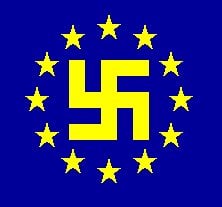 Many media outlets compare the contemporary situation in Europe
with the days before WWII. I would like to make an important correction
here. Now we are watching the West fostering another Nazi regime
represented by Kiev junta and it makes remember the second half of the
1930s when it did the very same thing cooperating with Germany turned
into a fascist state.
Many media outlets compare the contemporary situation in Europe
with the days before WWII. I would like to make an important correction
here. Now we are watching the West fostering another Nazi regime
represented by Kiev junta and it makes remember the second half of the
1930s when it did the very same thing cooperating with Germany turned
into a fascist state.